
A service degrades
The answer is spread across the estate
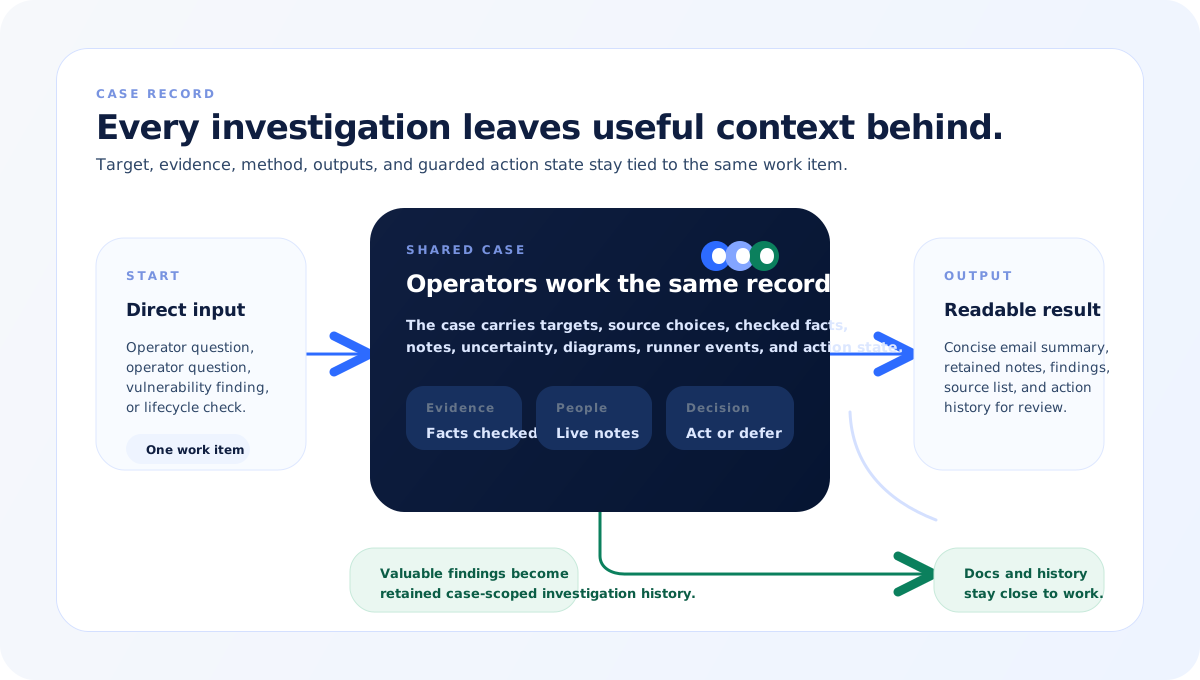
Someone opens the hypervisor, the load balancer, monitoring and the directory to piece together what is going on. The AI reads them through their own APIs and keeps the evidence in one case.
Zero-trust AI operations
Bring your own AI and let it work on production without handing it the keys. GAEZLA connects it to your systems through each vendor's own API. It helps you with a problem, answers a question, and drafts the change when one is needed. Nothing changes until an operator approves exactly what will run. Bring one real incident to the trial and check that on your own estate.
The problem
More systems, more obligations, the same people. AI could carry some of the work, if it could be trusted with production.
A service degrades
Someone opens the hypervisor, the load balancer, monitoring and the directory to piece together what is going on. The AI reads them through their own APIs and keeps the evidence in one case.
The change is clear
The change needs the right console, the right credential and someone to check it. GAEZLA drafts the exact change as a proposal; an operator approves it, it is fingerprinted at approval, and GAEZLA runs exactly that.
A review is due
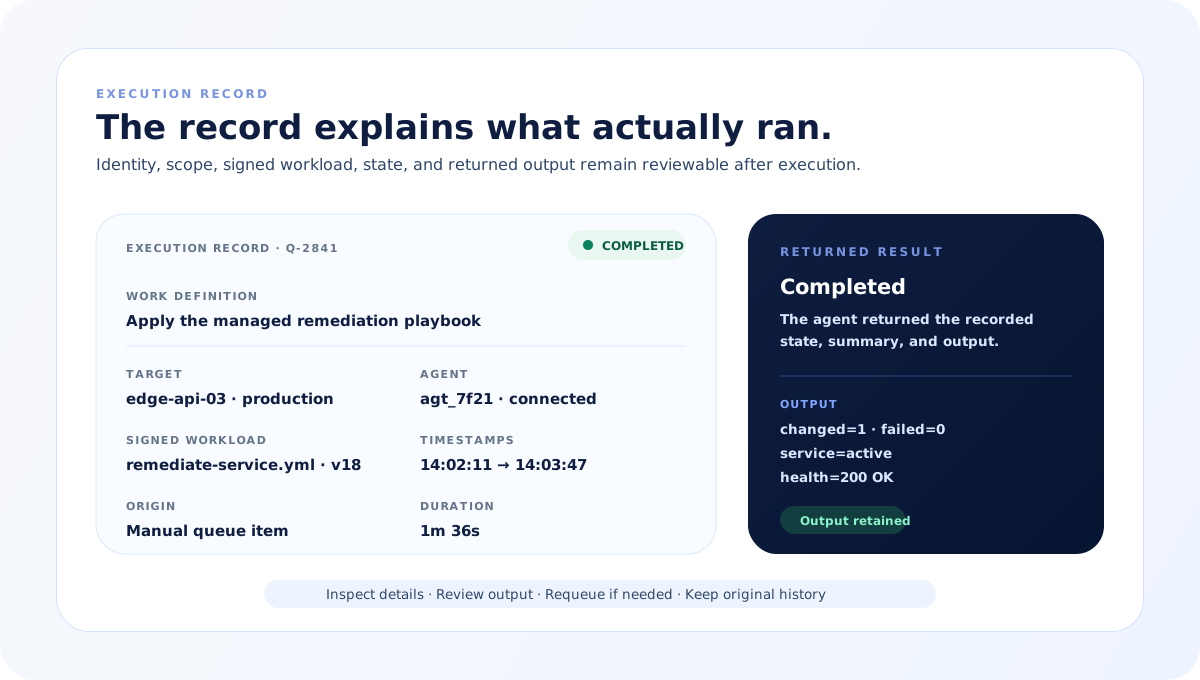
Who approved what, when, and what ran usually lives in tickets and chat. GAEZLA records each decision: who approved it, over which channel, under which requirement, when, and what ran.
What to verify
Start with one real incident. Check what the AI read, what it proposed, who approved it and what was recorded.
Point it at a real incident. Does the AI find what is going on across your systems, and is the proposed change the one you would have made?
Inspect the lead viewApprove one change. Can you see exactly what will run before you approve it, and does the record show what ran afterwards?
Inspect the operator viewAsk what the AI can reach and what it holds. Then put your own numbers into the calculator below, and test them during the trial.
Inspect the owner viewWhat you get
The AI searches each vendor's own API, reads live state across the systems you connect and keeps the evidence in one case, with the trail of how it got to its answer.
See how a case worksEvery change is drafted as a proposal with its evidence and exact content. An operator approves it, in the console or in their MCP client, and it is fingerprinted at approval. It then runs as an API call, a signed playbook or a pull request.
See approved executionThe code it writes runs with no network. Integration credentials stay inside GAEZLA, and a secret a job needs is sealed to the one host that runs it, after approval.
See the zero-trust architectureThe control question
The AI can propose something wrong. These controls are why it cannot run it on its own. An unattended routine cannot change your systems; it may only send mail to recipients you allow, under its own approval. Schedules run only the playbooks an operator set up.
Read the Security & Trust OverviewAn operator approves, in the console or in their MCP client, with multi-factor authentication if you require it. Approve and execute refuse machine tokens, and nothing in GAEZLA can approve a proposal.
The proposal is fingerprinted at approval, so it cannot be tampered with on the way. If it is, it does not run. Many changes can be approved as one decision, sealed together.
Linux and Windows agents run only signed playbooks and check the signer against the keys they trust. A playbook the AI drafts reaches a host only after an operator approves it.
Integration credentials stay inside GAEZLA. The AI sees the name of a secret, never its value. The value is released only after approval, sealed to one enrolled host and removed from the output.
Product records
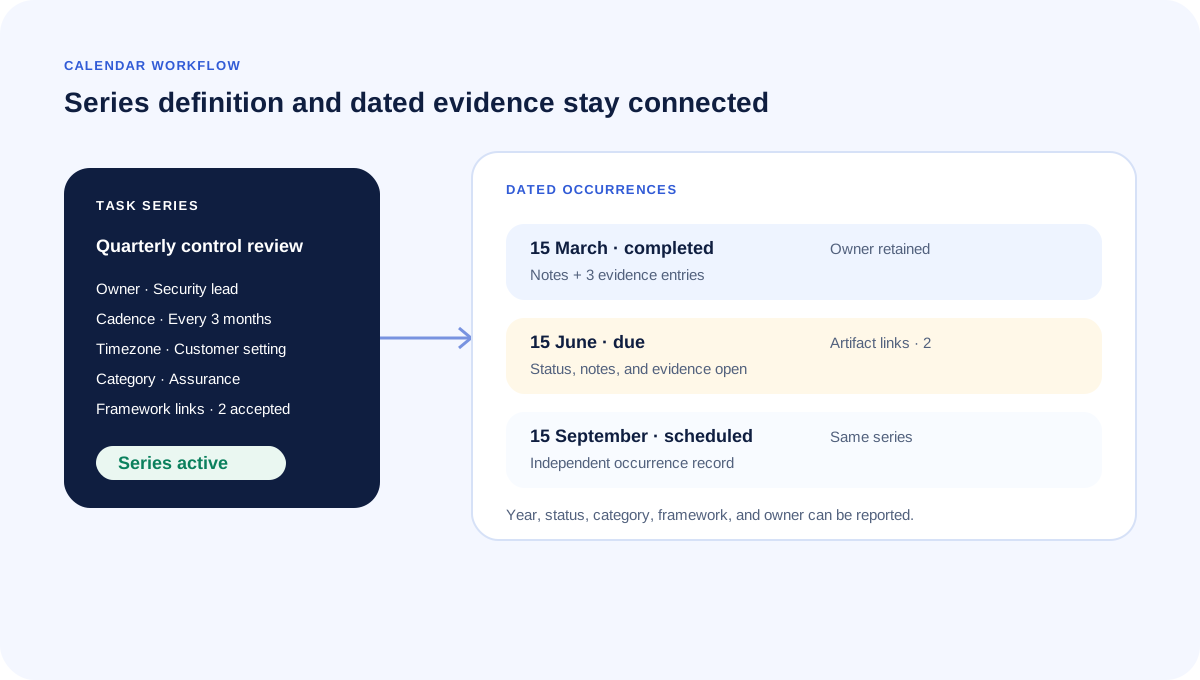
Illustrations of three records GAEZLA keeps: an investigation case, an agent run and a compliance occurrence.
ISO 27001 and NIS2
GAEZLA provides NIS2 and ISO 27001 workspaces for recorded answers and gaps, plus a calendar of recurring tasks. Each occurrence carries its own owner, due date, notes, evidence and artifacts, so evidence sits with the period it covers. Evidence is attached deliberately; GAEZLA does not infer compliance from operational telemetry.
The arithmetic
Put a number on an engineer's hour and on the hours you want to test reclaiming, then check them against real incidents during the trial. The reclaimed hours are your scenario, not a GAEZLA estimate.
The base plan equals about — per operator per month at the hourly cost you entered.
Uses 46 working weeks. This models the value of the hours you chose; it does not predict that GAEZLA will reclaim them. Base subscription only: managed hosts, additional seat blocks, support, onboarding, promotions, and tax are excluded.Configure the current total.
Plans
Each plan includes AI investigation and approved execution; higher plans add systems and workflows. These are base subscriptions. Hosts, seat blocks, support, onboarding, promotions and tax are set on the pricing page.
$599/month base
Investigation, approved execution and your own AI, across core systems.
Broader operating scope
$999/month base
Adds recurring automation, rightsizing and vulnerability operations.
$1,599/month base
Adds alert routing, hardening, NIS2 and ISO 27001, and just-in-time admin access.
Who is accountable
GAEZLA is built and operated by T1P5M4RK, LLC, a Delaware limited liability company. The company identity, contact path, legal terms, data-processing terms, sub-processors, and current security controls are public.
Each customer is provisioned with its own worker, its own database and its own storage buckets, and talks to the GAEZLA admin plane with a credential of its own.
Customer data is not used to train models without your written consent. Customer-configured AI providers process submitted data under the customer’s provider account and terms.
We hold no SOC 2, ISO 27001, HIPAA or PCI certification and claim none. We publish the controls, the DPA and the sub-processors instead.
Evaluate it on your estate
Connect one system, ask the question you had last week, and check three things: what the AI read, what it proposed, and what it took to approve it.